


Nollywood actress Etinosa Idemudia has stirred fresh controversy after declaring that Christianity and feminism cannot coexist.
In a post shared on X, the actress argued that the Christian faith is fundamentally rooted in patriarchy, insisting that anyone rejecting patriarchy is by extension, rejecting Christianity.
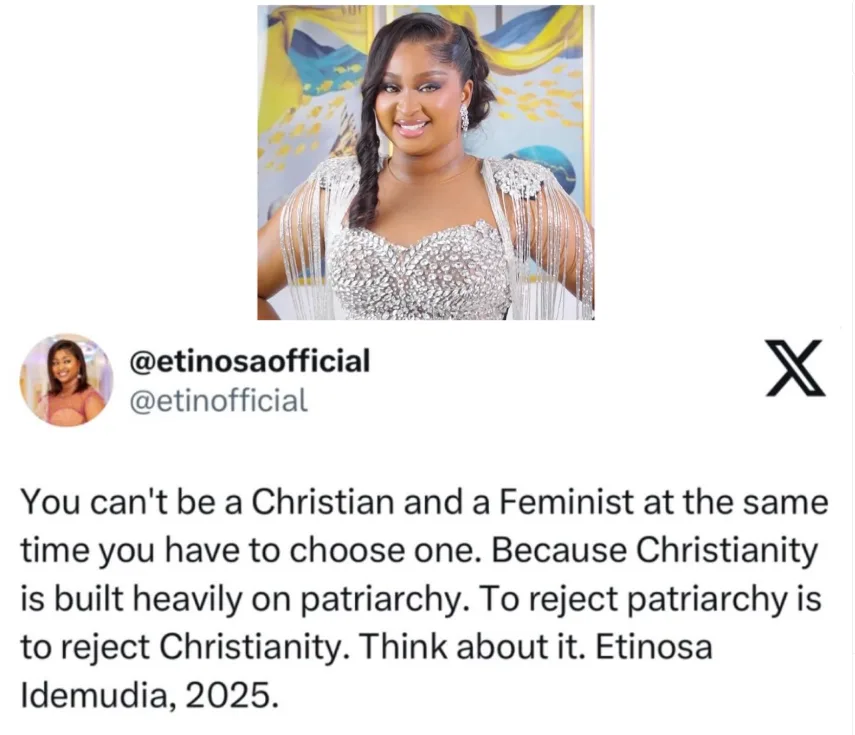
Her statement has triggered heated reactions online, with some users backing her for “saying the quiet part out loud,” while others accuse her of misunderstanding both Christianity and feminism.
The conversation continues to gain momentum as Nigerians debate where the lines of religion, gender ideology, and modern social movements should meet.
Reacting to her post, one Nenyenwarosita wrote, ““JUDGES 4:1-9 Ehud’s death, the Israelites again did evil in the Lord’s sight. So the Lord turned them over to King Jabin of Hazor, a Canaanite king. The commander of his army was Sisera, who lived in Harosheth-haggoyim. Sisera, who had 900 iron chariots, ruthlessly oppressed the Israelites for twenty years. Then the people of Israel cried out to the Lord for help. Deborah, the wife of Lappidoth, was a prophet who was judging Israel at that time. She would sit under the Palm of Deborah, between Ramah and Bethel in the hill country of Ephraim, and the Israelites would go to her for judgment. One day she sent for Barak son of Abinoam, who lived in Kedesh in the land of Naphtali. She said to him, “This is what the Lord, the God of Israel, commands you: Call out 10,000 warriors from the tribes of Naphtali and Zebulun at Mount Tabor. And I will call out Sisera, commander of Jabin’s army, along with his chariots and warriors, to the Kishon River. There I will give you victory over him.” Barak told her, “I will go, but only if you go with me.” “Very well,” she replied, “I will go with you. But you will receive no honor in this venture, for the Lord’s victory over Sisera will be at the hands of a woman.” So Deborah went with Barak to Kedesh.””
Zpeartie wrote, “Actually she has a point. When you start reading more on theology, you’ll question many things in the Bible as it’s deeply patriarchal. Deeply. There’s also the fact that as years went by, the Bible was revised and wordings changed to suit the patriarchal belief. The original Bible didn’t have lots of additions or questionable opinions like it does today. I am a Christian and a feminist. I believe in God and its existence, but I don’t practice religion. I practice spirituality. Spirituality is greater than religion. Knowing all these, I’m glad my experience are rooted from reading because enh, you’ll be lost if you just do follow follow”
Benny_orji wrote, “Jesus broke every patriarchal rule: talked to women publicly, let them fund his ministry, praised their faith above men’s. Claiming “Christian women can’t be feminists” isn’t biblical fidelity; it’s cultural idolatry with a Bible verse slapped on top”
Fikunademii wrote, “I don’t agree at all. Christianity is built on the radical idea that every human being, male and female, is made equally in the image of God. Genesis 1:27 says it plain: “male and female he created them,” same dignity, same value. Jesus spent his ministry lifting women up in a culture that treated them like property: talking theology with the Samaritan woman, letting Mary sit at his feet like a disciple, appearing first to women after the resurrection and trusting them to carry the news. Paul gets quoted a lot on “wives submit” and “women keep silent,” but people forget he also said in Galatians 3:28 there is no male or female in Christ, all one, all heirs together. He praised women like Phoebe the deacon, Junia the apostle, Priscilla who taught Apollos. The “household codes” everyone calls patriarchal were actually subversive for their time; they told husbands to love their wives like Christ loves the church, which means self-sacrificial love, not domination. Feminism, at its core, just wants women treated as full humans with equal worth and opportunity. That lines up perfectly with what Jesus lived and taught. The real clash isn’t between Christianity and feminism; it’s between Christianity and the cultural baggage some men slapped onto it later to keep power. Plenty of women (and men) follow Jesus fiercely and still fight for equality, because they believe the gospel demands it. History’s full of them: Catherine Booth, Dorothy Day, the women who hid in catacombs preaching while Rome burned Christians alive. They didn’t see any contradiction. So no, you absolutely can be both. In fact, if you take the Bible seriously, being a Christian should make you some kind of feminist, because Jesus was the original boundary-breaker for women.”