

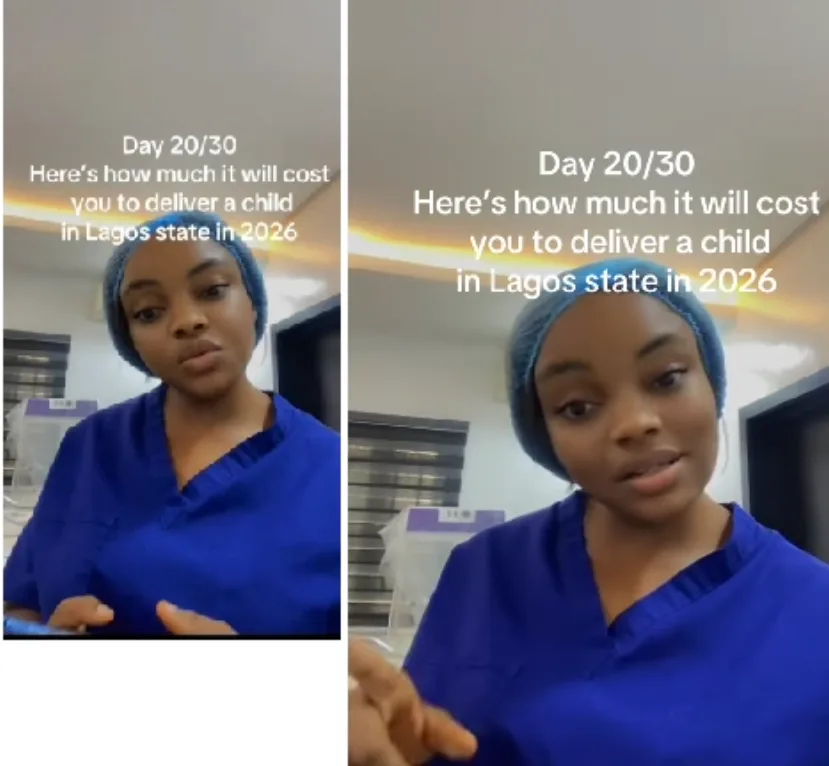
A Nigerian nurse has triggered widespread debate online after revealing the rising cost of childbirth in Lagos State, particularly in private hospitals on the Island, painting a stark picture of how expensive maternal care has become in 2026.
According to the nurse, expectant parents should prepare for antenatal care costs starting from about ₦450,000 and above, depending on the hospital and services involved. She explained that a normal vaginal delivery now costs roughly ₦800,000 and above, while an elective caesarean section (CS) ranges between ₦1.5 million and ₦1.8 million. In emergency situations, however, a CS can climb to ₦2 million or more.
She noted that delivery fees often exclude several critical procedures, which can quickly inflate hospital bills. For instance, phototherapy for newborn jaundice costs between ₦25,000 and ₦50,000 per day, while blood transfusion, which is not included in delivery costs, ranges from ₦60,000 to ₦100,000, depending on the blood group.
For rhesus-negative mothers, the nurse disclosed that the Rogam injection now costs about ₦110,000, adding another significant expense.
She further explained that Intensive Care Unit (ICU) admission, whether for the mother or baby, requires an initial deposit of ₦1.5 million to ₦3 million, excluding daily treatment charges. Other post-delivery procedures also come at a cost, with circumcision priced at ₦40,000 and above, and ear piercing ranging between ₦20,000 and ₦30,000.
Additional medical interventions can further strain finances. According to her, evacuation after complications costs from ₦300,000 upward, cervical cerclage starts at ₦400,000, and family planning after delivery costs ₦50,000 and above, depending on the chosen method.
The nurse emphasized that hospitals typically demand deposits before carrying out most procedures and warned that health insurance does not cover all expenses, urging families to plan ahead financially.
Her revelations have sparked intense reactions on social media, with many Nigerians expressing concern over the affordability of quality maternal healthcare and the growing financial pressure on young families in Lagos.