

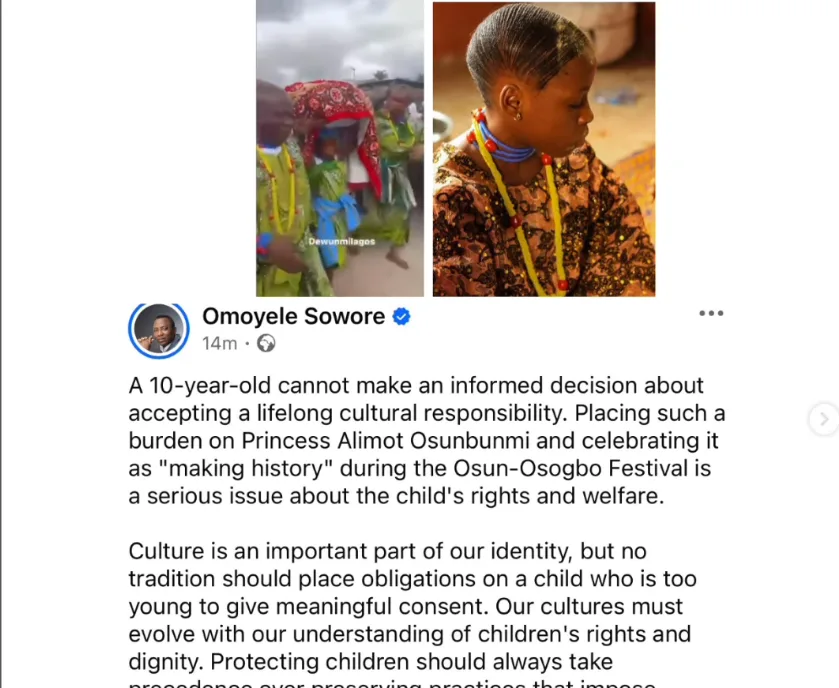
Human rights activist and former presidential candidate Omoyele Sowore has criticised the use of a 10-year-old princess as the Arugba (calabash carrier) during the 2026 Osun-Osogbo Festival, describing the practice as child abuse.
The controversy followed the annual procession to the Osun Sacred Grove in Osogbo, Osun State, on Thursday, August 7, where Princess Alimot Osunbunmi carried the sacred calabash as part of the festival’s traditional rites.
Festival organisers described the moment as “history in the making,” noting that Alimot is the youngest person ever selected to serve as the revered Arugba, a role regarded as one of the most significant in the centuries-old Osun-Osogbo Festival.
The young princess was chosen through Ifa divination in March 2025 to succeed Osuntomi Ewatomi, who served as Arugba for about 12 years before her tenure ended following her marriage, in line with tradition.
Reacting to the development, Sowore questioned the decision to assign such a role to a 10-year-old, arguing that a child of that age cannot meaningfully consent to participating in a religious or cultural ritual.
According to him, involving a minor in such a significant traditional ceremony raises concerns about children’s rights and informed consent.
His comments quickly generated mixed reactions across social media, with many Nigerians divided over whether the practice should be viewed through the lens of child protection or cultural preservation.
Supporters of Sowore argued that children should not be expected to participate in rituals or traditional responsibilities they may not fully understand, insisting that minors should be protected from obligations they are too young to consent to.
Others, however, defended the tradition, maintaining that the Osun-Osogbo Festival is an important aspect of Yoruba cultural heritage and that the Arugba is selected through longstanding traditional processes. Many argued that children also participate in religious activities within Christianity and Islam from an early age, suggesting that traditional beliefs deserve similar respect.
Some commentators compared the role to children serving as altar servers in churches, joining choirs, memorising religious texts, or participating in Islamic ceremonies, arguing that cultural and religious upbringing often begins in childhood across different faiths and traditions.
The debate has since evolved into a broader conversation about the balance between protecting children’s rights, preserving indigenous cultural practices, and respecting freedom of religion and tradition in a diverse society.
The Osun-Osogbo Festival, recognised by UNESCO as part of the world’s cultural heritage, remains one of Nigeria’s most celebrated traditional festivals, attracting thousands of worshippers, tourists, and cultural enthusiasts from within and outside the country each year.
Watch video below: